Enquiry
In practice & projects

Remote reading in practice: examples from real metering points.

How network operators, water suppliers and companies monitor metering points and machines remotely: eight projects from Austria and Germany, for gas, drinking water, municipal energy management and construction machinery.

Water · Carinthia

Municipality of Fresach: detecting continuous water draw before it goes unnoticed for months

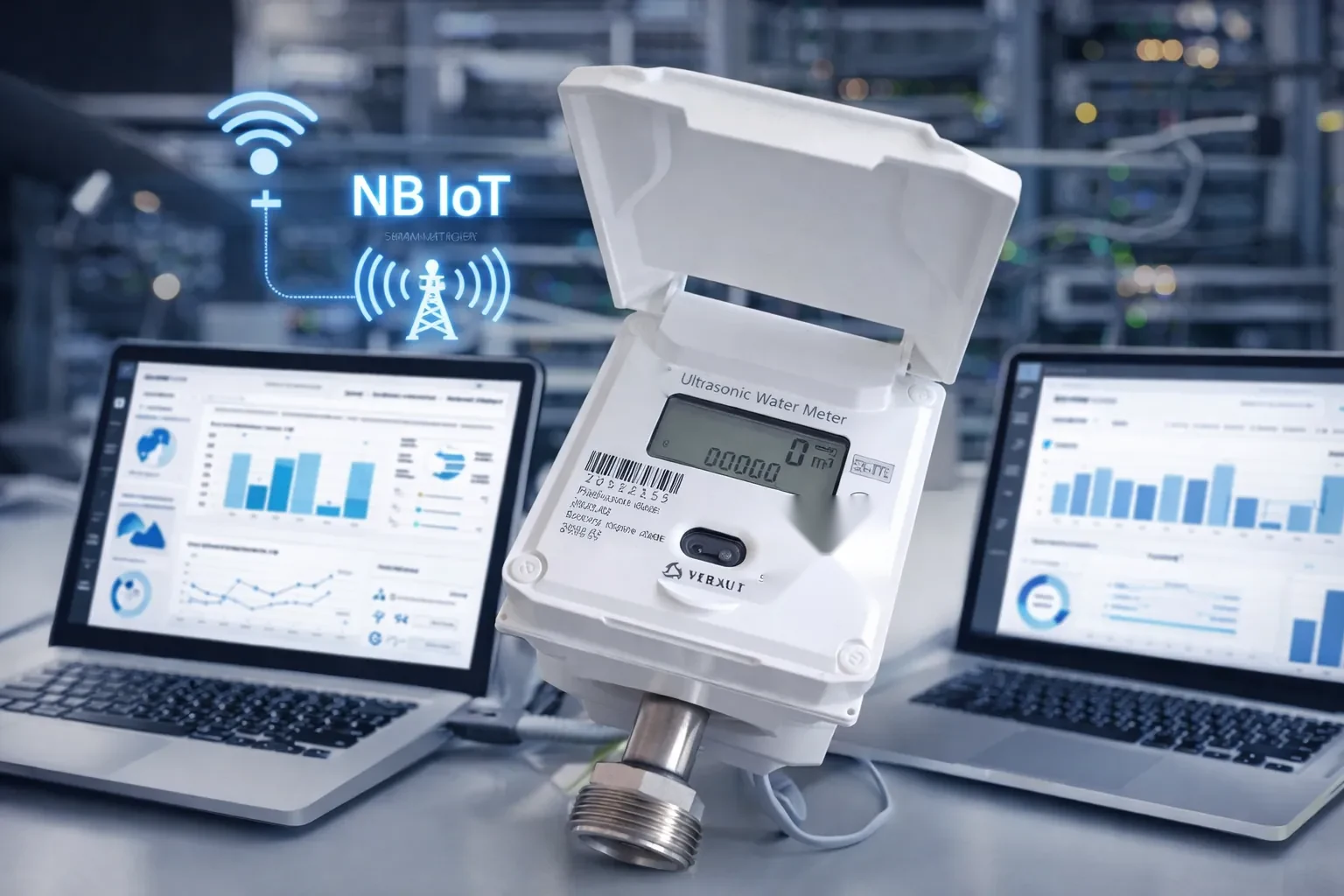
421 VUSWM ultrasonic water meters with integrated NB IoT Box MICRO: seven anomalies in the first six months, 99.5% transmission rate.

Read report ↓

Gas · Upper Austria

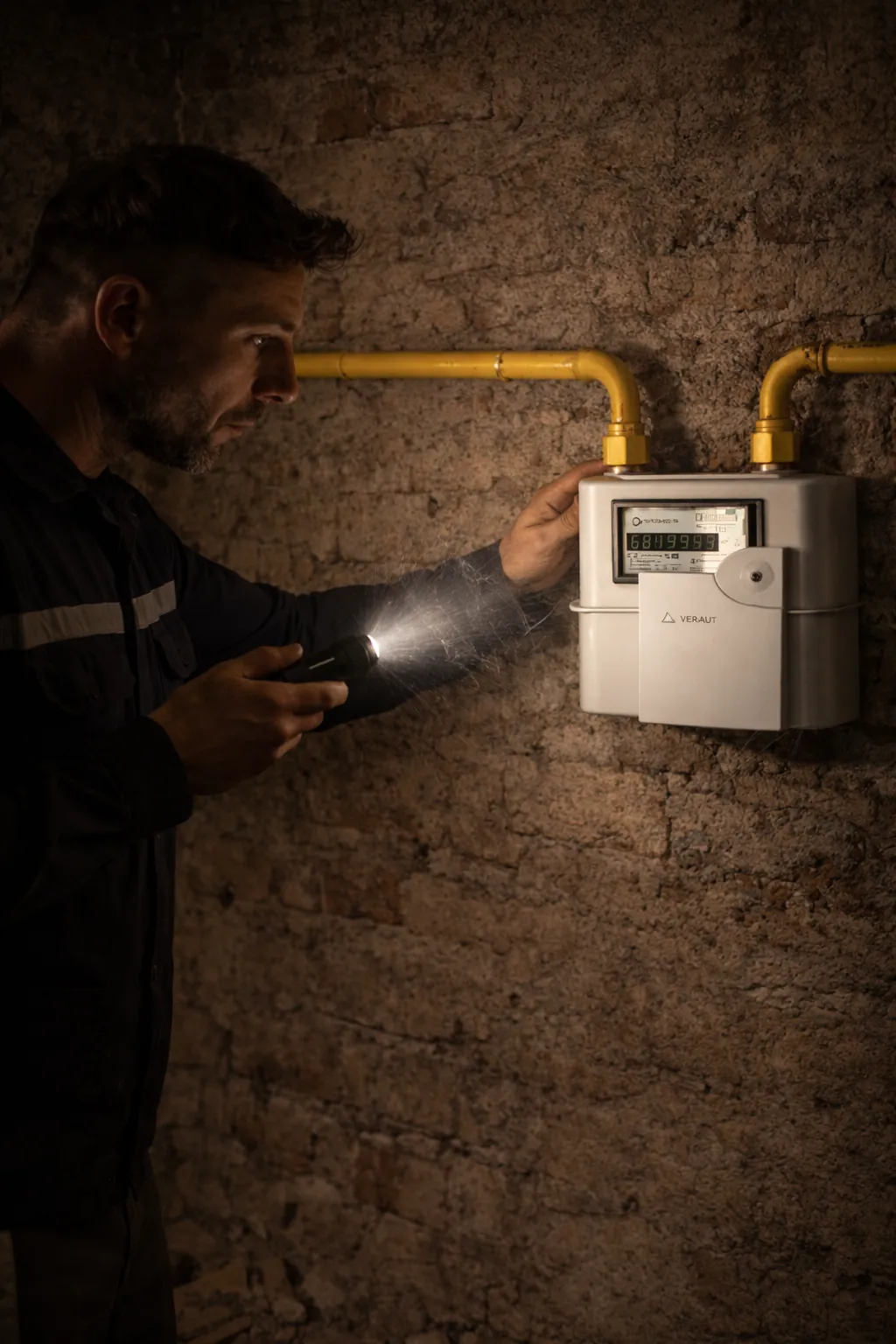
210 gas meters across Upper Austria retrofitted for hourly remote reading

No meter replacement, no additional power connection and no private radio network: Netz Oberösterreich GmbH relies on the VERAUT NB IoT Box LITE for automatic reading of existing gas meters.

Read report ↓

Water · Germany

Large water meters have delivered complete hourly values via NB-IoT since 2024

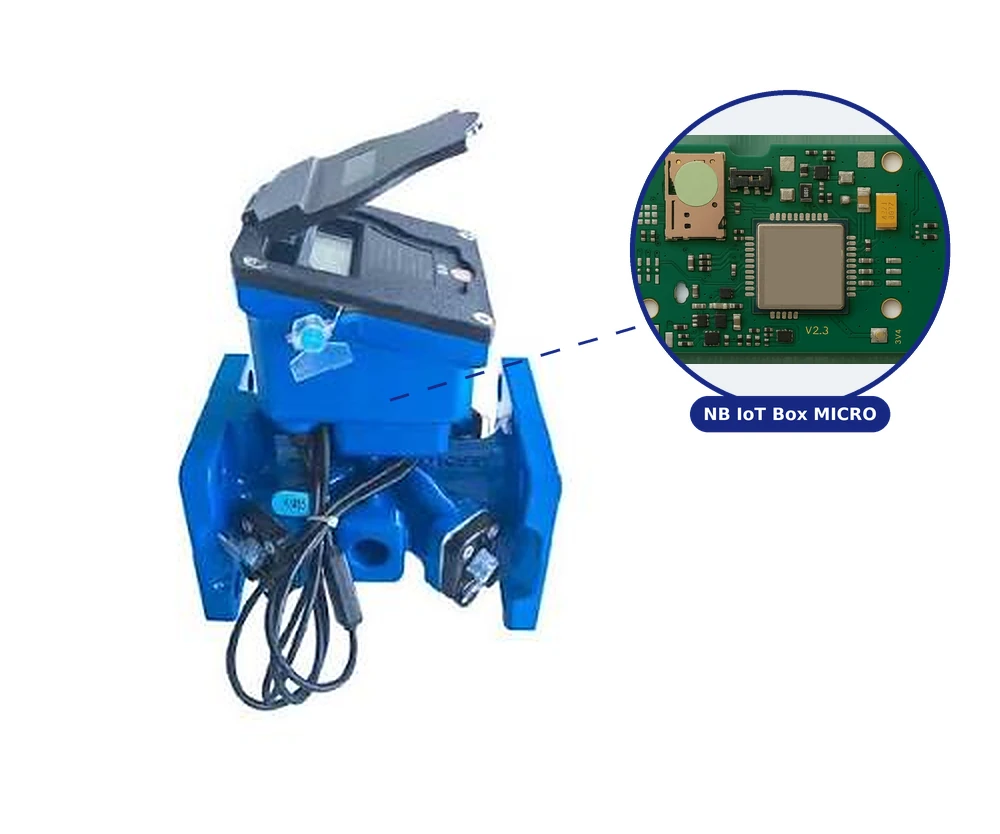
17 large water meters, hourly transmission and no missing hourly values since commissioning: ViWa GmbH from Bavaria relies on the integrated VERAUT NB IoT Box MICRO.

Read report ↓

Building and energy management · ViWa GmbH

37 public buildings read automatically since 2018

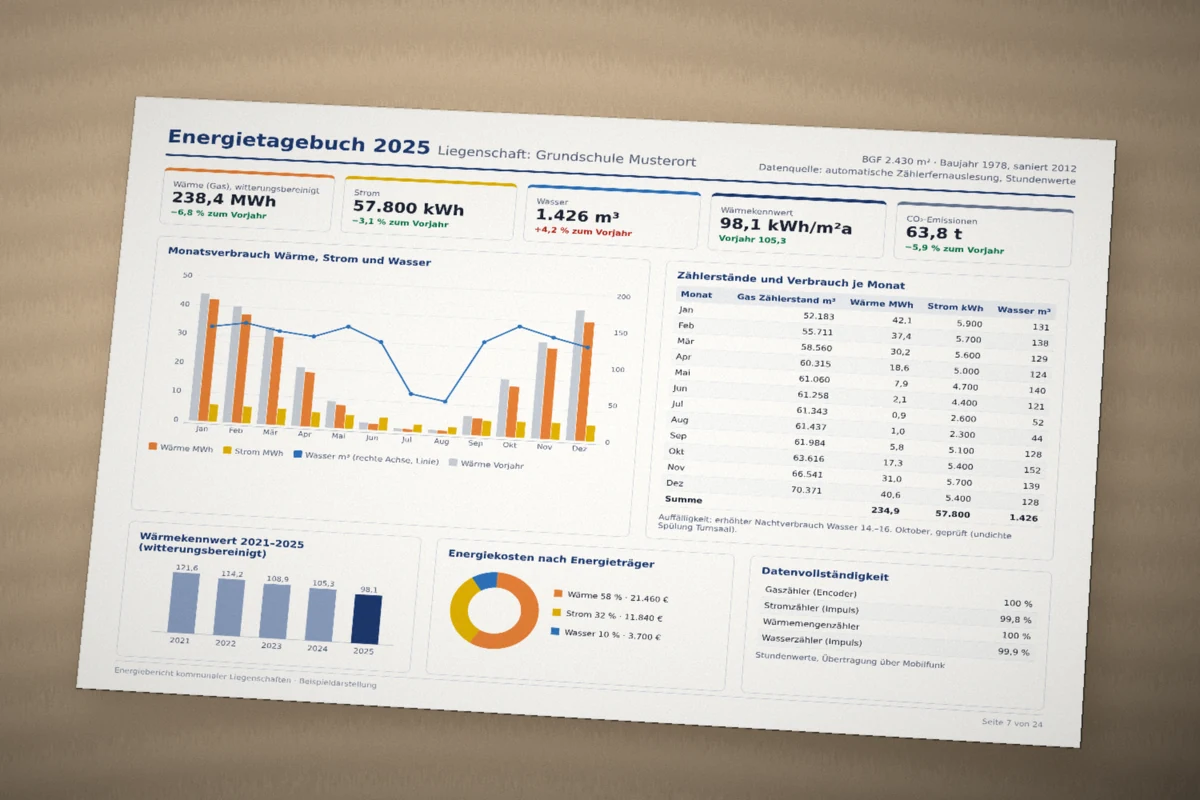
With VERIBOX-MINI and NB IoT Box LITE, ViWa records the gas, water, heat and electricity consumption of 37 public buildings. The data is transmitted automatically to the ViSo software and prepared there for energy logs and energy reports.

Read report ↓

Construction machinery · Upper Austria

Machine found in the Czech Republic: VERAUT tracking system pays for itself after two weeks

150 machines and tools, different power supply requirements and an individual solution for tracking and operation monitoring: VERAUT developed a system for Huemer GmbH based on the NB IoT Box GPS.

Read report ↓

Water · Reservoir

Reservoir reliably monitored since 2010, without any power connection

How the municipality of Obermoos monitors the water level of its reservoir with a battery-powered VERAUT solution and is alerted automatically when the level is low.

Read report ↓

Gas · Vienna

Wiener Netze: in use since 1996, network-wide since 2003

Load profiles from meters and electronic volume converters (EVCs) at the click of a mouse, with devices installed directly in the Zone 1 hazardous area. In use since 1996.

Read report ↓

Gas · Upper Austria

Energie AG / Netz OÖ: reliable EVC reading, no more site visits to chase missing data

Remote reading of large gas consumers as required by the Energy Efficiency Directive, battery-powered in a Zone 1 hazardous area.

Read report ↓

Water · Carinthia

Municipality of Fresach: detecting continuous water draw before it goes unnoticed for months

Starting point

The municipality of Fresach in Carinthia, Austria, used to read its water meters once a year. Small, continuously flowing quantities therefore often went unnoticed for a long time. The widespread municipality with six villages and more than 1,600 m difference in altitude also makes a private gateway infrastructure costly.

Solution

After eight months of pilot operation, installation of a total of 421 electronic VUSWM ultrasonic water meters (419 × DN20, 2 × DN40) with integrated NB IoT Box MICRO began in February 2026. The meters record hourly consumption and transmit it directly over NB-IoT to VERILOG, without a private radio network. Meter readings are provided digitally for municipal billing every month.

Alarm for continuous water draw

Within 24 hours there must be at least one hourly interval without consumption. If there is none, the system detects continuous water draw and raises an alarm. The municipality checks the message and informs the household concerned.

Rollout status

413 of 421 meters are installed. 411 transmit their hourly load profiles completely to VERILOG, a transmission rate of 99.5% of the installed meters. Two installed meters are currently not sending data; it is being checked whether they were affected during installation. Eight meters remain to be installed.

Result

In the first six months, seven leaks and unusual consumption patterns were detected, including four households with continuous water loss. Leaking toilet cisterns, taps or other small leaks can lose water day and night and remain inconspicuous at an annual reading. As a calculation example: 7 litres per hour add up to 61.3 m³ in a year. The 7 l/h are freely chosen, not an alarm threshold and not a measured loss.

Administration and energy

Meter reading is fully digital: meter data and readings arrive automatically several times a day, without on-site reading appointments, and can be exported directly to the municipal billing software. The NB IoT Box MICRO records its energy use and forecasts the remaining battery life. With weak reception, transmissions can be bundled; the stored hourly values remain fully resolved. The battery is designed for two calibration periods.

Gas · Upper Austria

210 gas meters across Upper Austria retrofitted for hourly remote reading

The challenge: reading distributed gas meters automatically

Netz Oberösterreich GmbH, a company of Energie AG Oberösterreich, operates gas infrastructure at numerous sites across the province.

The gas meters concerned are located in residential buildings, businesses and public facilities, often in basements, plant rooms or other hard-to-reach areas.

The aim of the project was to read the existing gas meters automatically and make hourly meter readings available centrally.

The installed meters were to remain in use, and neither a private radio network nor additional power connections at the metering points were to be built.

The solution: digital meter reading via NB-IoT

The existing gas meters have encoder indexes with SCR interface, which allow the meter reading to be read out digitally.

The battery-powered VERAUT NB IoT Box LITE is used for the retrofit. The compact data logger is fitted directly to the index and secured with a fixing screw.

Unlike acquisition via a pulse output, the NB IoT Box LITE reads the meter value digitally via the encoder interface.

The recorded hourly values are transmitted over the public NB-IoT mobile network to the VERAUT web portal VERILOG, where they are available for further processing.

Installation requires neither replacing the gas meter nor any work on the gas line. The meter reading also remains visible on the index.

No additional gateway or external power connection is needed.

The result: 208 of 210 metering points transmit completely

In the current project phase, 210 gas meters across Upper Austria have already been equipped with the NB IoT Box LITE.

208 of the 210 installed devices transmit their hourly values completely to VERILOG, a success rate of around 99%.

The two remaining metering points are at particularly demanding installation sites: one in a secured building area, the other on the second basement level of a railway station.

For these sites, antenna positioning and the installation situation are currently being reviewed to enable a reliable mobile connection there as well.

The project shows that existing gas meters with suitable encoder interfaces can be retrofitted for automatic remote reading with comparatively little installation effort, even with widely scattered metering points.

Water · Germany

Large water meters have delivered complete hourly values via NB-IoT since 2024

The challenge: providing consumption data reliably and promptly

ViWa GmbH, based in Cham, Bavaria, supports water utilities with the acquisition and remote transmission of measurement data.

For large water meters at inflow points, transfer points and larger consumers in particular, regularly available consumption values are of special interest.

They make it possible to evaluate consumption trends promptly, detect changes and base operations on current measurement data.

Instead of manual readings at longer intervals, a solution was sought that transmits the meter data automatically and reliably, without an additional power connection or a private radio infrastructure.

The solution: NB-IoT directly in the large water meter

For the project, 17 large water meters with nominal sizes DN 80 to DN 100 were equipped with the VERAUT NB IoT Box MICRO.

The compact communication module is integrated directly into the meters. It takes over the recorded meter data and transmits it hourly over the public NB-IoT mobile network to the VERAUT web portal VERILOG.

No separate gateway infrastructure or external power supply is required at the metering points.

In VERILOG the transmitted values are available centrally. Consumption trends can be displayed and evaluated graphically, making daily peaks and unusual night-time consumption easier to spot.

The result: 17 metering points without missing hourly values

Since commissioning in 2024, the solution has run stably.

All 17 large water meters transmit their hourly values completely to VERILOG. No data gaps have been found in project operation so far.

ViWa GmbH thus has a reliable basis for the regular evaluation of water consumption at the connected metering points.

The customer particularly values the stable data transmission and the complete availability of the hourly consumption values.

“The values arrive reliably every hour, without gaps. The solution has run stably since installation, and we are very satisfied.”

Managing director, ViWa GmbH
Building and energy management · ViWa GmbH

37 public buildings: consumption data recorded automatically since 2018

The challenge: consumption data from numerous public buildings

Schools, nurseries, administrative buildings, depots and other municipal facilities use energy and water every day. Effective energy management requires recording this consumption regularly and comparing it over longer periods.

With 37 buildings and a range of gas, water, heat and electricity meters, manual reading would mean considerable time and staff effort. In addition, changes in consumption are often only noticed with a significant delay when reading intervals are long.

The aim was therefore a solution that reads existing meters automatically, ideally without replacing them, and brings their consumption data together centrally.

The solution: automatic remote meter reading with VERAUT data loggers

ViWa GmbH from Cham in Bavaria has used battery-powered VERAUT data loggers for this since 2018.

With the VERIBOX-MINI and the NB IoT Box LITE, the existing meters are connected via suitable interfaces.

Depending on the meter type, data is acquired via pulse outputs or encoder interfaces, for example. For meters with a pulse output, consumption is calculated from the recorded pulses and the configured pulse value. Compatible encoder indexes allow the meter reading to be read out digitally.

The data loggers transmit the recorded values automatically over mobile radio. No additional power connection at the installation site and no local gateway infrastructure is required.

The readings from the 37 connected buildings are transmitted to ViWa’s ViSo software.

There the data is brought together centrally and made available for further evaluation.

The result: energy logs and energy reports based on automatically recorded consumption data

Since 2018, the consumption data of the 37 public buildings has been recorded automatically with the VERAUT data loggers and transmitted to ViSo.

Regular manual reading of the connected meters is no longer needed.

The collected readings allow ViWa to track and evaluate gas, water, heat and electricity consumption over different periods.

Changes in consumption and unusual patterns can therefore be detected earlier than with annual readings only.

On this basis, ViWa prepares the energy logs and energy reports for the connected public buildings.

Automatic data acquisition thus not only reduces the effort of collecting data but also creates a regularly available and traceable basis for municipal energy management.

The project shows how existing meters for different media can be integrated into central energy data acquisition with battery-powered data loggers.

Construction machinery · Upper Austria

Machine found in the Czech Republic: VERAUT tracking system pays for itself after two weeks

The challenge: where are the machines, and which are actually in use?

Huemer GmbH from Engerwitzdorf in Upper Austria specialises in concrete drilling and sawing. Its equipment includes core drills, wall and wire saws, diesel generators and transport vehicles.

These machines are used on changing construction sites and are regularly moved between locations.

It was therefore important for the company not only to know where individual machines are, but also to be able to tell whether a device is actually in operation.

A particular challenge was the different technical equipment of the machines: some have their own power supply, others are connected to vehicle power, and others have no electrical supply at all.

A uniform standard tracker could not adequately cover these requirements.

The solution: individual equipment tracking with operating state detection

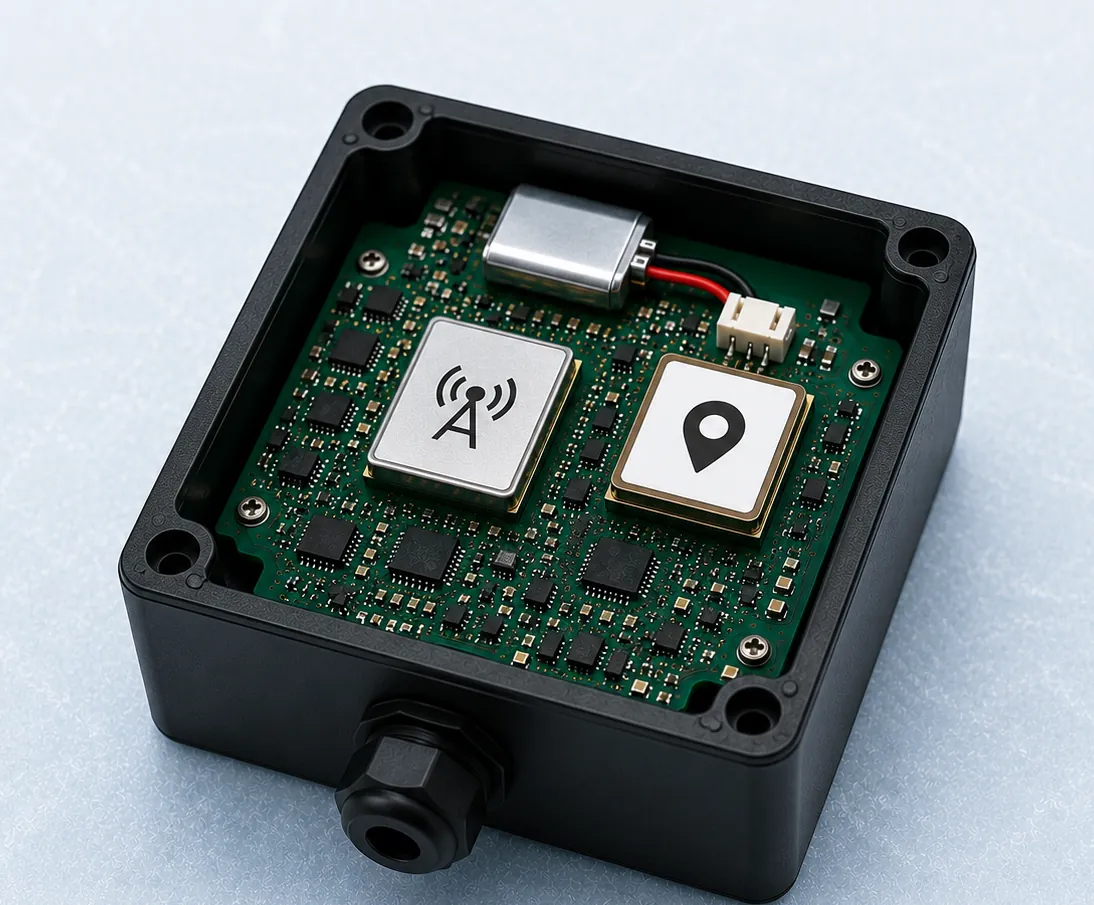
Together with Huemer GmbH, VERAUT developed a solution tailored to the machine fleet based on the NB IoT Box GPS.

Different versions are used depending on the machine type:

  • Core drills and saws: versions with rechargeable battery and external power supply.
  • Vehicles and diesel generators: connection to the existing vehicle power.
  • Machines without their own power supply: battery-powered tracking units.

In addition to GPS positioning, the system records further signals depending on the device to detect the operating state.

These include, for example, the current draw of an electrically driven machine, the alternator W signal on suitable generators, or vibration.

This shows not only where a device is, but also whether there are signs of active operation.

The electronics are potted and designed for the demanding conditions on construction sites. Before wider use, prototypes were first tested under real operating conditions at the customer.

The result: a missing machine located after two weeks

In the first project phase, 150 machines and tools were equipped with the VERAUT solution.

Just two weeks after introduction, the concrete benefit became clear.

A machine had not returned as planned after a job. With the tracking system, its location in the Czech Republic was determined.

The machine was recovered and returned to the equipment pool.

According to the customer, this incident alone meant the tracking system had paid for itself after two weeks.

Today the solution gives Huemer GmbH an overview of the locations and operating states of its machines.

This information makes scheduling easier, helps identify unused equipment and can serve as a basis for planning maintenance and operating times.

The project also shows how VERAUT can adapt existing communication technology to different machine types and customer-specific requirements.

“After two weeks the system had paid for itself. Today we always know where our machines are.”

Management, Huemer GmbH
Water · Reservoir

Reservoir reliably monitored since 2010, without any power connection

The challenge: level monitoring without a power supply

The reservoir of the municipality of Obermoos has no power connection. Conventional electrical level monitoring would therefore have required laying a power cable, or the water level would have had to be checked on site regularly.

The aim was a solution that works independently of the power grid, records the level reliably and informs the responsible water supervisor in good time as soon as the water supply reaches a critical value.

The solution: pressure probe and battery-powered data transmission

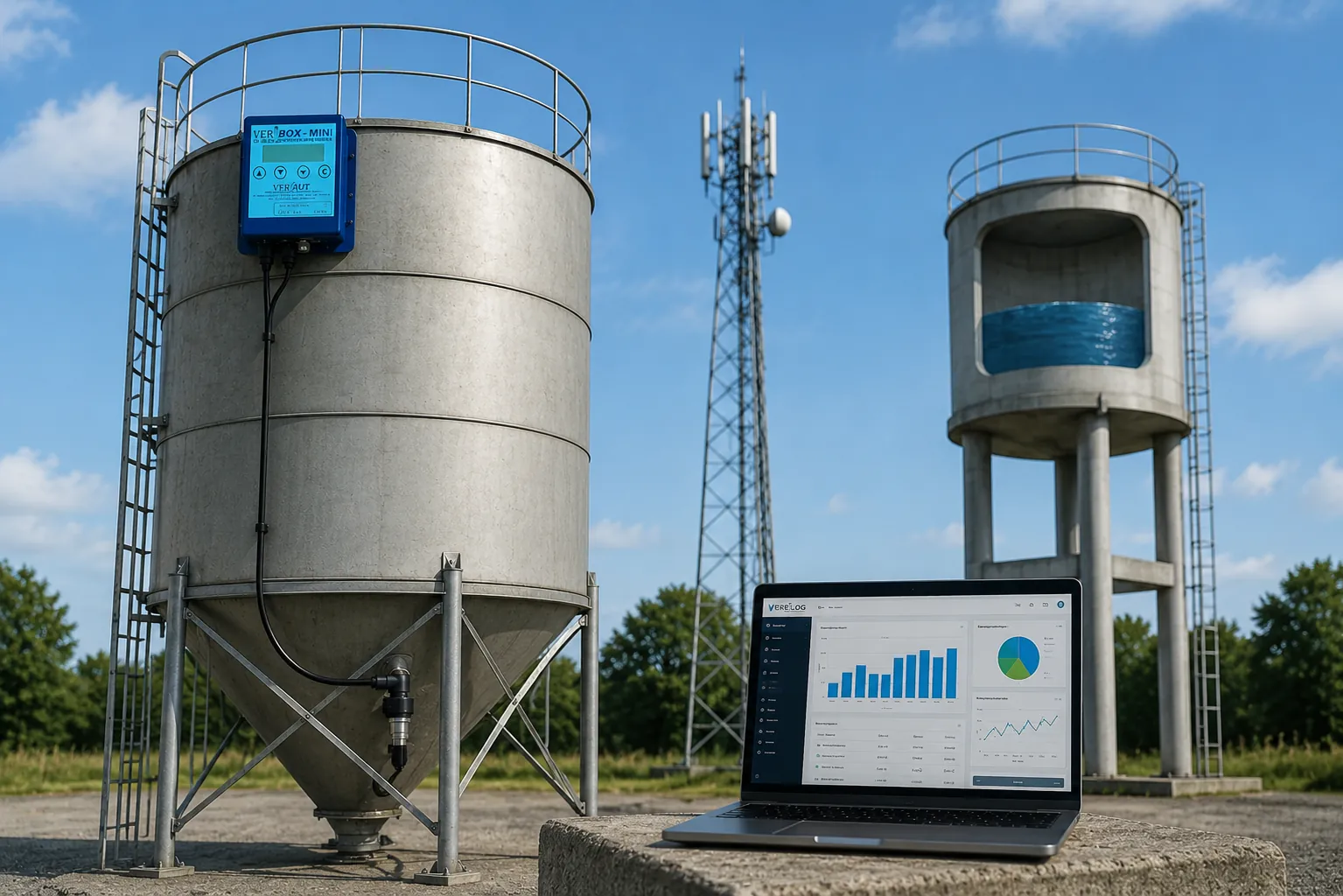
Since 2010, a VERAUT MOBILE SILO solution with the battery-powered VERIBOX-MINI data logger has been used for this.

A hydrostatic pressure probe immersed in the reservoir measures the pressure of the water column, from which the current level is determined.

The connected VERIBOX-MINI records the value every hour and stores it in its internal memory. Twice a day, the data logger transmits twelve hourly values at a time over mobile radio to the VERAUT web portal VERILOG.

A lower level limit of 30% was defined for alarms. If the device detects that the level has fallen below this value, it triggers an additional transmission. VERILOG then notifies the water supervisor by SMS.

This means there is no need to wait for the next regular transmission to become aware of a low water level.

The result: proven since 2010

The solution has been in reliable operation since 2010, without an external power supply at the reservoir.

The water supervisor can view the latest transmitted level values and their trend at any time in VERILOG. If the defined minimum level is undercut, an alarm notification is sent automatically.

Measures can thus be taken in good time before the water supply drops further. Regular inspection trips just to read the level are no longer necessary.

The example shows how even remote water supply facilities can be monitored permanently with battery-powered measurement technology.

Gas · Vienna

Wiener Netze: in use since 1996, network-wide since 2003

Starting point

Wiener Netze operates the gas network of the city of Vienna. Consumption at large gas consumers must be recorded as an hourly load profile. Meters and EVCs are located in gas metering stations, usually without mains power and in a hazardous area.

Solution

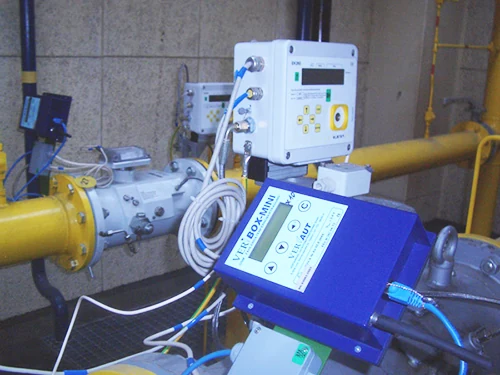
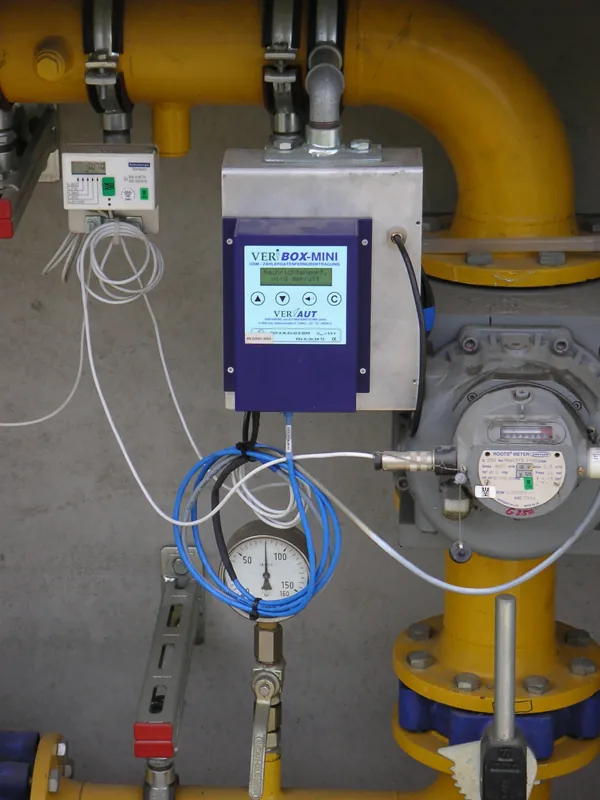
In 1996 the first VERIBOX-MINI went into operation at Wiener Netze. In 2003 the full rollout followed at the gas metering points of large consumers, with an hourly load profile. The VERIBOX-MINI reads meters and EVCs as well as station data such as pressure and temperature. Because it is certified for Zone 1 and battery-powered, it is mounted directly in the hazardous area, wherever it fits best in the station.

Further development

The VERIBOX-MINI has been developed continuously: a display and button menu for commissioning on site, low-power operation that reduces service at the station to battery replacement, and since 2015 4G LTE with fallback to 3G/2G where available.

Result

The metering data go electronically straight into the network operator’s systems. Fully automatic data collection saves on-site readings and administrative work.

“With the ATEX-certified, battery-powered VERIBOX-MINI we are not tied to a location outside the explosion zone.”

Wiener Netze (translated)
Gas · Upper Austria

Energie AG / Netz OÖ: reliable EVC reading, no more site visits to chase missing data

Starting point

Automatic remote reading is mandatory for large gas consumers. Meters and electronic volume converters (EVCs) are read every hour on the hour, and the data is sent as a load profile to E-Control, the Austrian energy regulator. Most gas metering stations have no mains connection, and the devices have to be installed in a Zone 1 hazardous area. Devices from other manufacturers used previously had not worked reliably.

Solution

The VERIBOX-MINI is certified for Zone 1 and battery-powered, so it can be mounted directly in the station, radio transmission included. The EVCs are read serially via RS232 or RS485, together with other operating data.

Result

Remote reading runs reliably. The only regular site work is battery replacement, about every five years with daily transmission. Site visits to chase missing data are no longer needed.

“Only with the VERIBOX-MINI did the remote reading of volume converters and other operating data work smoothly and without problems.”

Energie AG / Netz OÖ GmbH (translated)

Would you like to present your project? Get in touch.

Your project as a reference?

We are happy to document successful installations together with you.

Let’s talk about your metering point.

Briefly describe your application, meter type, installation site and hazardous area zone. We reply within up to three working days.

VERAUT GmbH · Derfflingerstraße 14/C/3 · 4020 Linz, Austria
+43 732 386361-0 · info (at) veraut.com

What is it about?
0